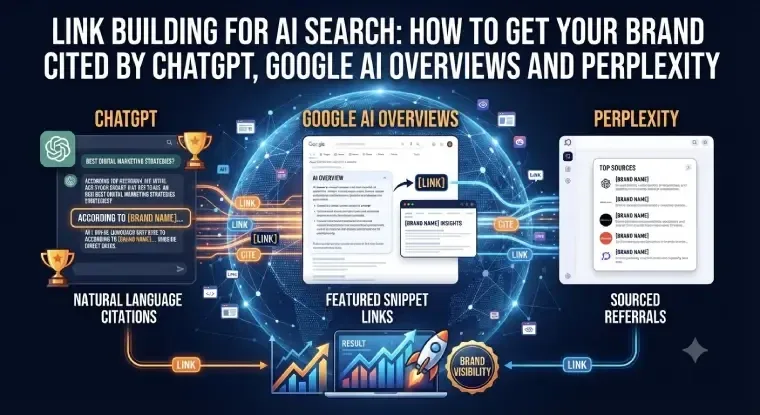
Link Building for AI Search: How to Get Your Brand Cited by ChatGPT, Google AI Overviews and Perplexity
By Zubair Pateljiwala ·
Explore this post with:
Try this before you read on. It takes two minutes.
Open ChatGPT and type the question your customers would ask. If you run a physio clinic in Bristol, ask: "What's the best physio clinic in Bristol for a running injury?" If you sell vegan protein powder, ask: "What's the best vegan protein powder in the UK?"
Now look at the answer. Is your brand in it? Then ask Google the same question and check the AI Overview at the top. Then try Perplexity.
If you're missing from all three, you're not alone. Most small brands are. And the reason usually isn't your website. It's what the rest of the web says about you, or doesn't say.
That's what link building for AI search is about.
The short version
Link building for AI search means getting your brand named and linked on relevant, trusted websites, so AI tools like ChatGPT, Google AI Overviews and Perplexity are more likely to mention or cite you.
Backlinks still help. But the data shows that brand mentions matter even more. In an Ahrefs study of 75,000 brands, web mentions were linked far more closely to AI Overview visibility than raw backlinks (0.664 vs 0.218).
So the best links do both jobs at once: they name your brand on a site your customers read, and they link to you.
Want your brand named on sites your customers already read? Browse relevant publishers on Link2Rank |
How do AI tools decide what to cite?
Short answer: AI tools search the web, read several sources and build one answer from them. They tend to repeat what many trusted sources agree on. So if lots of relevant sites mention your brand, you're far more likely to appear.
When you ask Google's AI Mode or AI Overviews a question, it doesn't just run one search. Google says it may use a technique called "query fan-out":
"Both AI Overviews and AI Mode may use a "query fan-out" technique — issuing multiple related searches across subtopics and data sources — to develop a response." (Google Search Central)
Here's what that looks like in real life. Someone asks: "What are the best running shoes for flat feet?" Behind the scenes, the AI might also look up "running shoes for overpronation", "shoes podiatrists recommend" and "best running shoes 2026 reviews". Then it pulls the brands that keep coming up across all those results.
ChatGPT and Perplexity work in a similar way when they search the web. Perplexity even shows its sources as numbered links under each answer, so you can see exactly where it got its information.
The key point is this: AI tools repeat what the web says. They don't judge your product themselves.
A famous real example shows how far this goes. In May 2024, soon after AI Overviews launched in the US, people noticed Google suggesting you add glue to pizza sauce to stop the cheese sliding off. The advice was traced back to an old joke comment on Reddit. Google fixed it quickly, but the lesson stuck. The AI wasn't thinking. It was repeating something it found on the web.
That cuts both ways. If the web says good things about your brand, in the right places, AI tools are more likely to say them too.
And the good news? Google says you don't need any special tricks to be included:
"There are no additional requirements to appear in AI Overviews or AI Mode, nor other special optimizations necessary." (Google Search Central)
In other words, the same things that build trust in normal search build trust in AI search. Being mentioned by the right sites is one of the biggest.
How often do AI answers appear in search?
Short answer: Often, and more often for longer, question-style searches. Studies put AI Overviews at somewhere between about 15% and 26% of Google searches, depending on the sample and the month.
Here's what the main studies found:
WebFX analysed 2.37 million US queries in 2025: "25.8% of 2.37 million US queries we analyzed surfaced an AI Overview box." For informational queries, that rose to 39.4%. For queries of seven words or more, it was 54.7%. (WebFX)
Semrush tracked more than 10 million keywords through 2025. AI Overviews appeared for 6.49% of queries in January, 24.61% in July and 15.69% in November. (Semrush)
Pew Research Center tracked real searches by 900 US adults. 18% of their searches showed an AI summary. (Pew Research Center)
The numbers jump around because Google keeps testing. Even Google says AI Overviews "often don't trigger", because they only show when they add something to normal results.
You can see the pattern in your own searches. Type "plumber near me" and you'll usually get a map and local listings. Type "why is my boiler losing pressure and how do I fix it?" and you're much more likely to see an AI answer at the top.
That matters for you. The longer, "help me decide" questions your customers ask are exactly the ones where AI answers show up most. That's where you want your brand named.
Do backlinks still matter for AI search?
Short answer: Yes, but not on their own. Backlinks still help you rank, and ranking still feeds AI answers. But brand mentions are linked much more closely to AI visibility. The best links give you both: a link and your brand's name.
The clearest data comes from Ahrefs. It studied 75,000 brands to see which factors were most closely linked to being mentioned in Google's AI Overviews.
What the data says
Factor | Correlation with AI Overview mentions |
Branded web mentions | 0.664 |
Branded anchor text | 0.527 |
Branded search volume | 0.392 |
Domain Rating (DR) | 0.326 |
Number of referring domains | 0.295 |
Number of backlinks | 0.218 |
Source: Ahrefs, 75,000 brands. A correlation of 1 would be a perfect link; 0 would be none.
As Ahrefs put it: "Web mentions (0.664) correlate much more strongly than backlinks (0.218)."
The gap between brands was huge. Brands in the top 25% for web mentions averaged 169 AI Overview mentions. The next quarter averaged 14. The bottom quarter averaged 0.
Look at the second row, too. Branded anchor text (a link where the clickable words are your brand name) came second. So a link that names you is worth more for AI visibility than a link that doesn't.
You can see this in action yourself. Ask ChatGPT "What's the best CRM for a small business?" You'll usually see names like HubSpot, Zoho and Pipedrive. That's no accident. Those brands appear in hundreds of "best CRM" roundups, reviews and comparison articles across the web. The AI has read about them again and again.
One honest note: correlation isn't cause. These brands may get mentioned in AI answers and on the web because they're big and popular. But for a smaller brand, the practical lesson is the same. Get your name onto the relevant sites your customers read.
That's the thinking behind how we built Link2Rank. Big brands get talked about everywhere without trying. Smaller brands have to earn their place in those conversations, one relevant site at a time. A marketplace simply makes it quicker to find the sites worth being on.
Also read: How to Choose the Right Publisher for Link Building
Backlinks, brand mentions and citations: what's the difference?
Short answer: A backlink is a clickable link to your site. A brand mention is your brand's name on another site, linked or not. A citation is when an AI tool names you or links to you as a source in its answer. Links and mentions are what you build. Citations are what you hope to earn.
These three words get mixed up a lot, so here they are side by side.
Term | What it means | Who controls it |
Backlink | A link from another website to yours. | You can earn it, build it or buy it. |
Brand mention | Your brand's name on another website, with or without a link. | You can influence it through PR, guest posts and sponsored posts. |
AI citation | An AI tool naming your brand, or linking to your page as a source, in its answer. | Nobody. The AI tool decides. |
In one sentence each:
A backlink is a link on another website that points to yours.
A brand mention is any time your brand's name appears on another website.
An AI citation is when ChatGPT, Google AI Overviews, Perplexity or another AI tool names you or links to you in an answer.
Here's a real-life way to picture all three in one place.
Say you run an online shop selling hand-poured soy candles. A popular home and lifestyle blog publishes "10 Best Soy Candles for Cosy Winter Evenings". Your brand is number three on the list, with a short review and a link to your shop.
That single article gives you a brand mention (your name in the review) and a backlink (the link to your shop). If enough similar articles mention you, an AI tool asked "What are the best soy candles in the UK?" has a good reason to include you. That would be the citation.
You can't control the last step. But you can control the first two.
In the candle example, the hard part is finding that home and lifestyle blog in the first place, then checking it has real readers. That's the job Link2Rank was made for: you browse sites by niche, look at each one before you order, and only pay for placements that suit your brand.
Also read: What Is Link2Rank? A Simpler Way to Think About Link Building
Is ranking in Google still enough to get into AI answers?
Short answer: It helps, but it's no longer enough. In 2026, only 37.9% of the pages cited in AI Overviews ranked in Google's top 10 for the same search. AI tools now pull from a much wider set of sources.
This is one of the biggest shifts in the data.
In a 2026 study of 863,000 keyword results and 4 million AI Overview URLs, Ahrefs found that 37.9% of cited pages ranked in the top 10. In its mid-2025 study, the figure was about 76%. Even more surprising, 31.0% of cited pages didn't rank in the top 100 at all. (Ahrefs)
Why? Think back to query fan-out. The AI isn't just reading the results for your exact search. It's reading the results for lots of related searches too. A page that ranks for "how to choose a winter duvet tog" could get cited in an answer about "best duvet for a cold bedroom", even if it doesn't rank for that second search at all.
The same study found that YouTube made up 5.6% of cited URLs. You'll see this yourself if you search for something practical, like "how to bleed a radiator". AI answers often point to a video.
So what does this mean for you?
Ranking still counts. A strong page that ranks well is still one of your best routes into AI answers.
Your brand needs to appear beyond your own site. If you only exist on your own website, you're relying on one page to do all the work.
Being mentioned across many relevant pages widens the net. Each one is another place the AI might read about you.
That's where link building for AI search earns its keep.
Which contextual backlinks help most in AI search?
Short answer: Contextual backlinks that name your brand, on relevant sites your customers already read. A link inside a useful article, with your brand name nearby or in the anchor, gives you both a backlink and a brand mention. That's the combination the data rewards.
Contextual backlinks are links placed inside the main body of an article, surrounded by related text. They're the opposite of links hidden in footers, sidebars or long lists of random sites.
Here's what makes one work harder for AI search.
1. Your brand is named, not just linked. Compare these two sentences on a fitness blog:
"For a cheap option, click here."
"For a budget pick, GreenScoop sells a vegan pea protein blend that's popular with runners."
The second one names the brand and says what it's known for. An AI tool reading that page learns who sells what, and for whom. The first one teaches it nothing. (GreenScoop is a made-up name, just to show the style.)
2. The anchor text includes your brand. Remember, branded anchor text had a 0.527 correlation with AI Overview mentions in the Ahrefs study. That was second only to web mentions. So mix in anchors like "Brightside Physio" or "the team at Brightside Physio", not just "best physio in Bristol".
3. The site is relevant to your niche. A pet food brand mentioned on a respected dog training blog makes sense. The same mention on a casino review site doesn't. AI tools look for patterns, and relevance builds the right pattern. That's why it pays to buy niche relevant backlinks, not just any link with a high score.
4. The site is trusted and has real readers. High authority backlinks still matter. Domain Rating had a 0.326 correlation in the same study. But authority on its own is not the goal. A smaller blog with a loyal audience in your niche can be worth more than a big general site nobody reads.
5. The article answers a real question. Roundups, comparisons, "how to choose" guides and reviews are exactly the pages AI tools read when someone asks for a recommendation. Being named in "The 7 Best Accounting Apps for UK Freelancers" is worth far more than a link in an unrelated news post.
6. It's clearly labelled if it's paid. Sponsored posts are fine when they're honest. Google asks for paid links to carry a rel="sponsored" or rel="nofollow" attribute. The good news for AI search is that a labelled sponsored post still puts your brand name in front of readers and AI tools. That's why many brands now use a sponsored post marketplace for exactly this kind of placement.
So which placement type gives you all six? Usually a guest post or sponsored post in a relevant article, because you help shape what's written about you. A niche edit on an older article that already ranks can work well too, as long as the page talks about your topic and your brand is named.
This is where a guest post marketplace helps. Instead of emailing hundreds of site owners, you can see relevant sites in your niche, check them, and pick the ones your customers actually read.
Ready to get your brand named on relevant sites? Buy guest posts online from 10,000+ vetted publishers on Link2Rank |
How do you make your brand easy for AI tools to cite?
Short answer: Make your brand easy to understand and easy to find. Keep your brand facts the same everywhere, answer real questions clearly on your own site, and get named on relevant sites in your niche. Then keep going steadily, month after month.
Here are seven steps that work together.
1. Keep your brand facts the same everywhere. AI tools build a picture of you from many sources. If those sources disagree, the picture gets blurry. Picture a bakery whose website says it opened in 2015, its Google Business Profile says 2018, and an old directory still lists a shop it closed years ago. An AI tool may repeat any of those. Check your website, Google Business Profile, LinkedIn, social profiles and main directories. Make your name, address, what you do and who you serve match.
2. Say clearly what you do, in plain words. Your homepage and About page should answer "Who are you, what do you sell, and who is it for?" in the first few lines. "We're a Bristol physio clinic that helps runners recover from injury" is easy for an AI tool to repeat. "We unlock human potential through movement" isn't.
3. Get named on relevant sites in your niche. This is the core of link building for AI search. Aim for mentions in the places your customers already read: niche blogs, industry magazines, local news sites, comparison articles and expert roundups. A wedding photographer named in "Best Wedding Venues in the Cotswolds and the Photographers Who Know Them" is in exactly the right conversation.
If you don't know where to start, list the five or six types of site your customers read, then look for real examples of each. On Link2Rank you can browse publishers by niche, which turns a week of searching and emailing into an afternoon of choosing.
4. Use your brand name in your anchor text. As we saw, branded anchors were the second strongest factor in the Ahrefs study. Use your brand name, or your brand plus a short description, for a good share of your links. Save keyword-heavy anchors for the odd one.
5. Answer the questions your customers really ask. AI tools love clear answers. Write pages that start with a direct answer, then explain. A garden centre could publish "When should I plant tulip bulbs in the UK?" and answer it in the first sentence. That page can be read, quoted and cited.
6. Keep your key pages fresh. Old prices, old dates and old advice make a page less useful. Update your most important pages at least once or twice a year, and show the date you last updated them.
7. Grow steadily, not in bursts. Ten relevant mentions spread over five months look natural. A hundred links in one week from random sites don't. Slow and steady builds a reputation that sticks, in Google and in AI tools.
How can you check if AI tools mention your brand?
Short answer: Ask them. Once a month, put your customers' real questions into ChatGPT, Google, Gemini and Perplexity, and log whether you're mentioned or cited. Then check Search Console and GA4 for traffic from AI tools. Watch the trend over months, not single answers.
Here's a simple monthly routine that takes about 30 minutes.
List 10 to 20 buying questions. Use the questions customers ask you on the phone or by email. For a dog groomer: "best dog groomer in Leicester", "how often should a cockapoo be groomed?", "is a hand stripping groomer worth it?"
Ask each AI tool. Use ChatGPT, Google (AI Overviews and AI Mode), Gemini and Perplexity.
Log what you see in a simple spreadsheet. Were you mentioned? Were you linked as a source? Which competitors showed up? Which websites did the AI cite?
Study the cited sources. This is the most useful step. If Perplexity keeps citing the same two blogs when it answers questions in your niche, those are the sites you want to be mentioned on.
Check Search Console. Google says traffic from AI features is included in your Performance report under the "Web" search type. It isn't shown separately, so look at the trend for the pages you're working on.
Check GA4. Look at referral traffic from sites like chatgpt.com, perplexity.ai and gemini.google.com. Many sites set up a custom channel group so AI traffic sits in its own line.
Step 4 often gives you your next shopping list. Once you know the kinds of sites AI tools trust in your niche, check whether those sites, or ones like them, are open to guest posts or sponsored posts. It's worth searching for them on Link2Rank before you start cold emailing.
Also read (for agencies): White Label Link Building for Agencies: The 2026 Playbook
One warning: AI answers change. Ask the same question twice and you may get two different lists. That's why you track over months, not days.
Is it worth the effort? The traffic is still small but valuable. In a WebFX study of 2.3 billion sessions, AI tools sent just 0.18% of sessions, and ChatGPT sent 82.6% of that AI traffic. But AI visitors "converted ~1.2x higher than organic search". (WebFX) People who arrive from an AI answer have often already been told you're a good fit.
Meanwhile, AI answers are changing how people click. Pew Research Center found that when people saw an AI summary, they clicked a normal search result in 8% of visits. Without one, they clicked in 15%. Clicks on links inside the summary itself happened in "just 1% of all visits". (Pew Research Center)
So fewer people click. That makes being named in the answer more important than ever, because for many people, the answer is all they'll read.
What doesn't work for AI search?
Short answer: Shortcuts. Private blog networks, link farms, irrelevant links, keyword-stuffed anchors and "AI files" that promise special treatment won't help. Some of them can get your site penalised in Google, which hurts your AI visibility too.
Here's what to skip.
PBNs and link farms. Networks of sites built only to sell links don't have real readers. They don't build a real reputation, so they don't help AI tools trust you. Google's spam policies also treat them as link schemes.
Links from irrelevant sites. A dental clinic mentioned on a crypto gambling blog builds the wrong pattern. If anything, it confuses the picture of what you do.
Keyword-stuffed anchors. Fifty links that all say "best emergency dentist London" look unnatural to Google and tell AI tools nothing about your brand.
Special "AI text files". You may have heard of llms.txt and similar files. Google is clear: "You don't need to create new machine readable files, AI text files, or markup to appear in these features. There's also no special schema.org structured data that you need to add." (Google Search Central)
Chasing every new AI hack. Every month there's a new trick on social media. Most are guesses. The brands that show up in AI answers year after year are the ones people actually talk about.
Stick to white hat backlinks from real sites with real readers. They're slower than shortcuts, but they keep working, in Google and in AI tools.
It's also why we vet every publisher before it goes on Link2Rank, and why each order comes with a live link guarantee. A shortcut that disappears in three months helps nobody, least of all your AI visibility.
What nobody can promise you
Be wary of anyone who guarantees you'll be cited by ChatGPT, Google AI Overviews or Perplexity. Nobody can promise that, including us.
AI tools decide for themselves. No publisher, agency or marketplace controls what they say.
Answers change from one run to the next. You might be named on Monday and missing on Tuesday.
The studies show correlation, not cause. Brand mentions are closely linked to AI visibility, but that doesn't prove one causes the other.
What you can control is whether relevant, trusted sites talk about your brand. That's what gives AI tools a reason to mention you.
Frequently asked questions
Do backlinks help you show up in ChatGPT?
They can help, but mostly indirectly. When ChatGPT searches the web, it reads pages that rank well and pages that mention brands often. Backlinks help you rank, and links that name your brand also count as brand mentions. A link from a relevant article that names you does far more than a link that doesn't.
Are brand mentions more important than backlinks?
For AI visibility, the data says yes. In Ahrefs' study of 75,000 brands, web mentions had a 0.664 correlation with AI Overview mentions, against 0.218 for the number of backlinks. But you don't have to choose. A contextual link inside an article that names your brand gives you both at once.
Do I need llms.txt, special files or schema to appear in AI answers?
No. Google says you don't need new machine readable files, AI text files or special schema.org markup to appear in AI Overviews or AI Mode. Normal good practice still applies: a fast, crawlable site with clear, helpful content. Spend your time on content and mentions, not on special files.
How long does link building for AI search take to work?
Think in months, not weeks. A new mention has to be published, found and read before AI tools can use it, and AI answers shift over time. Most brands should track their mentions monthly and judge progress over three to six months. Steady, relevant mentions beat a sudden burst of links.
Can I pay to be cited by AI tools?
No. ChatGPT, Google AI Overviews and Perplexity choose their own sources, and nobody can sell you a guaranteed citation. What you can pay for is a clearly labelled sponsored post or guest post on a relevant site. That gets your brand named in the right places, which gives AI tools a reason to mention you.
How do I know if AI tools mention my brand?
Ask them directly. Once a month, put 10 to 20 real customer questions into ChatGPT, Google, Gemini and Perplexity, and log whether you're named or cited. Then check referral traffic from chatgpt.com and perplexity.ai in GA4. Because answers change from run to run, look at the trend over several months.
The bottom line
AI search hasn't replaced link building. It has changed what a good link looks like.
A link used to be about passing authority from one page to another. That still matters. But AI tools also read the words around the link. They want to know who you are, what you do and who trusts you. The brands that get named in AI answers are the ones the web keeps talking about.
So focus on the links that do both jobs: contextual links on relevant sites your customers read, with your brand's name front and centre. That might be a sponsored post on a respected niche blog, a mention in a comparison article or a few high DR guest posts in your industry. Ten of those will do more for you than a hundred links from sites nobody reads.
"AI tools don't read your sales page and take your word for it. They look at what the rest of the web says about you. Every relevant site that mentions your brand by name is one more voice in that conversation." — Donnie, Founder, Link2Rank
That's exactly what a good link building marketplace should help you do. On Link2Rank, you can browse 10,000+ vetted publisher sites across 55+ niches, choose the ones your customers really read, and place guest posts, sponsored posts or niche edits with a live link guarantee.
Get Your Brand Mentioned Where AI Tools Look for Answers |