
Guest Posts, Niche Edits and Link Insertions Explained
Priya sells eco-friendly dog food from a small online shop. Last month she finally set aside a budget for links, messaged a publisher on a popular dog blog, and got a reply she wasn't ready for:
"Happy to help. Do you want a guest post, a niche edit or a link insertion?"
She stared at it for a while. They all sounded like the same thing. So she did what most of us would do and picked the cheapest one.
It wasn't a disaster, but it wasn't the right choice either. Priya wanted to push one page, "grain-free dog food", from page 2 to page 1 of Google. A different placement would have helped that page far more, for not much extra money.
If you've ever been in Priya's shoes, this guide is for you. We'll keep coming back to her as we go, because these terms make much more sense with a real example.
What's the difference between guest posts, niche edits and link insertions?
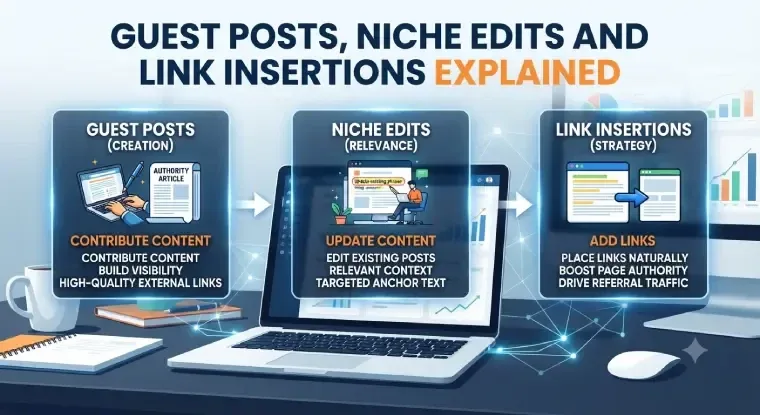
A guest post is a brand-new article on someone else's site, with your link inside. A niche edit is your link added to an article that's already published. A link insertion is a type of niche edit where existing words on the page are turned into your link.
The simple rule: choose a guest post when you want control and brand exposure, and choose niche edits or link insertions when you want a link on a page that already has age, traffic and trust.
Below, you'll see how each one works, what it usually costs, how to judge the site behind it, and how to pick the right one for the page you want to grow.
Want to compare them side by side? Browse guest posts and niche edits from 10,000+ vetted sites on Link2Rank |
In this guide
What are the main types of paid backlinks?
What is a guest post?
What is a niche edit?
What is a link insertion?
Guest posts vs niche edits vs link insertions: which should you choose?
How to judge the site: DA vs DR
Anchor text tips for every placement
Are these placements safe?
How much does each placement cost?
Do these placements help with AI answers?
How to order guest posts and niche edits on Link2Rank
FAQs
What are the main types of paid backlinks?
The three main types of paid backlinks are guest posts, niche edits and link insertions. Each one is a different "placement", which simply means where and how your link appears on the publisher's site.
Before we compare them, two quick terms you'll see a lot:
Editorial link. A link a site gives you because it chooses to, not because you paid.
Sponsored link. A link you paid for. Google asks that these are marked with rel="sponsored" (more on that below).
Whatever you buy, aim for contextual backlinks. That means your link sits naturally inside a relevant sentence, in the main body of the page, not in a footer or sidebar.
Here's how the three placements compare at a glance:
Guest post | Niche edit | Link insertion | |
What it is | A new article with your link | Your link added to an existing article | Existing words on a page turned into your link |
Content | New | Existing (may add a sentence) | Existing (no new text) |
Page age and traffic | Starts from zero | Already built up | Already built up |
Control over the content | High | Medium | Low |
Typical cost | Lower | Higher | Varies |
Best for | Brand exposure, topic relevance | Boosting a page that needs a push | Quick, natural-looking placements |
So there's no single best placement, only the best one for your goal. Let's look at each in turn.
What is a guest post?
A guest post is a new article you (or the publisher) write for another website, with a link back to your site inside the content. It's the most familiar type of placement, and it gives you the most control over the story around your link.
Think of it like this: a guest post is like writing a column for your local newspaper. You choose what to say, and your name sits at the bottom. But it's a brand-new page, so nobody has read it yet.
Priya's example: she writes "5 Signs Your Dog Has a Food Allergy" for a popular pet care blog. Inside the article, she links to her grain-free dog food page. She controls the topic, the words and the link, and readers of a dog blog get to know her brand.
Guest posting is still one of the most popular link building tactics. In Aira's State of Link Building survey of 270 SEOs, 47% said they use guest posting, up from 42% the year before (Aira).
But it hasn't always had a good reputation. Back in 2014, Google's then head of webspam, Matt Cutts, famously wrote:
"Okay, I'm calling it: if you're using guest blogging as a way to gain links in 2014, you should probably stop." — Matt Cutts (mattcutts.com)
What many people miss is that he later added: "There are still many good reasons to do some guest blogging (exposure, branding, increased reach, community, etc.)." In other words, spammy guest posting died. Good guest posting didn't. As one SEO on Reddit put it: "What doesn't work anymore is mass posting for links." (Reddit)
Pros
Full control over the topic, angle and anchor text.
Brand exposure in front of a new, relevant audience.
Usually cheaper than a niche edit.
Cons
Starts from zero. A new page has no age, traffic or links of its own yet.
Takes longer. Writing, editing and approval all add time.
Little direct traffic. In an Ahrefs survey, the average referral traffic across 239 guest articles was only 50 visits (Ahrefs). Buy a guest post for the link and the relevance, not for clicks.
A guest post on a relevant site is a solid link you control. Just don't expect it to bring a flood of visitors.
What is a niche edit?
A niche edit is a link to your site added to an article that's already published on another website. Because the page already exists, it may already have age, traffic and links of its own, and your link benefits from all of that straight away.
Think of it like this: a niche edit is like getting your shop added to a "best local shops" list that's already pinned on the community noticeboard. People already read and trust the list. Your name just joins it.
Priya's example: a well-known dog blog has an article from 2023 called "Best Diets for Dogs With Sensitive Stomachs". It already ranks on Google and gets steady traffic. The publisher adds one sentence recommending grain-free options, with a link to Priya's page. Her link goes live on a page that's already trusted.
That's why niche edits often cost more. In a study Ahrefs ran a few years ago, paid niche edits cost $361.44 on average, compared with $77.80 for paid guest posts (Ahrefs). They're also harder to find on your own: only 12.6% of the sites Ahrefs contacted were willing to sell a link in an existing article.
Pros
Instant authority. The page has already earned trust and may already rank.
Faster. No new article needs to be written and approved.
Natural fit. A good niche edit sits inside content that's already relevant to your topic.
Cons
Costs more on average.
Less control. You work within the existing article, so your anchor text and context must fit what's already there.
Quality varies. Some sellers cram many paid links into old posts, so check the page's outbound links carefully.
If the page is relevant, indexed and already getting traffic, a niche edit is usually worth the extra cost.
What is a link insertion?
A link insertion is when the publisher turns existing words in a published article into a link to your page, without adding new text. It's the lightest-touch placement there is.
Priya's example: the same dog blog already has this sentence in an article: "Many owners now switch to grain-free dog food when their dog has a sensitive stomach." With a link insertion, the publisher simply turns the words "grain-free dog food" into a link to Priya's page. Nothing else on the page changes.
You'll often see "niche edit" and "link insertion" used to mean the same thing, and many sellers do treat them as one product. Where people do separate them, the difference is simple:
Niche edit: the publisher may add a new sentence or short paragraph to make room for your link.
Link insertion: the publisher links a phrase that's already on the page.
Because nothing new is written, a link insertion only works when the existing sentence already matches your page. If the words don't fit, a niche edit (with a short added sentence) is the better choice.
When to use link insertions
The page already mentions your topic in a natural phrase.
You want a quick turnaround with minimal changes to the article.
You're happy with partial-match or branded anchor text, since you're working with existing wording.
One tip before you order: ask the seller to show you the exact sentence your link will sit in.
Guest posts vs niche edits vs link insertions: which should you choose?
Choose the placement that matches your goal. Guest posts suit brand exposure and new topics. Niche edits suit pages that need a push from an established article. Link insertions suit quick, light placements where the wording already fits.
Here's a simple guide:
Your goal | Best placement | Why |
Build your brand in a new niche | Guest post | You control the story and get your name in front of a new audience |
Push a page that's sitting on page 2 | Niche edit | A link from an aged, ranking page passes trust faster |
Get a link live quickly | Link insertion or niche edit | No new article to write and approve |
Stretch a tight budget | Guest post | Usually cheaper per link |
Control your anchor text | Guest post | You write the sentence around the link |
Look as natural as possible | Niche edit | Your link sits in content that was already there |
Priya's plan: her goal is to push one page from page 2 to page 1, so she starts with one niche edit on a relevant article that already ranks. To build her brand among dog owners over time, she adds one guest post a month on pet care blogs. When she spots an existing sentence that already mentions "grain-free dog food", she uses a link insertion for a quick, natural win.
Most growing sites end up using a mix. A few guest posts build brand and topical relevance. A few niche edits give your key pages a stronger push.
Whatever you choose, relevance comes first. One SEO on Reddit summed it up well: "Too often, people acquire links that are completely irrelevant to the topic, which undermines the entire SEO effort." (Reddit)
"Most buyers ask us which link type is best. The honest answer is the one that fits the page you want to grow. A niche edit on a relevant article that already ranks will often do more than a brand-new guest post, but a guest post gives you full control of the story." — Donnie, Founder, Link2Rank [APPROVE QUOTE]
Not sure which to pick? Browse placements by niche on Link2Rank |
Start with the page you want to grow, and the right placement usually becomes obvious.
How to judge the site: DA vs DR
Domain Authority (DA) and Domain Rating (DR) are third-party scores that estimate a site's link strength. They're useful for a quick first filter, but they don't tell you whether a site is relevant, trusted or read by real people.
DA is Moz's score, from 1 to 100.
DR is Ahrefs' score. In Ahrefs' words: "Domain Rating (DR) is an Ahrefs metric that shows the relative strength of a website's backlink profile." (Ahrefs)
Most SEOs lean on DR. In Editorial.Link's 2026 survey of 518 SEO professionals, 64.1% said Ahrefs DR/UR was their preferred authority metric, compared with 15.4% for Semrush Authority Score and 11.6% for Moz DA/PA (Editorial.Link).
But here's the catch, straight from Ahrefs itself:
"DR doesn't account for backlink SPAM. In fact, large amounts of low-quality backlinks may actually increase your DR, not decrease it." — Ahrefs
That's why high DR guest posts and high DA guest posts aren't automatically good. As one Reddit user said: "If a site with a DA of 89 is linking out to 1 million websites, that backlink is going to be pretty worthless I have to imagine." (Reddit)
Priya's example: she's offered two sites. Site A has a DR of 70 but writes about loans, crypto and travel, and gets very little traffic. Site B has a DR of 35, writes only about dogs and gets thousands of monthly visits from UK dog owners. Site B is the better buy for Priya every time, even though its score is lower.
Look at:
Organic traffic and where it comes from
Topic fit with your site
Outbound links. In the same survey, 89.0% of SEOs named spammy outbound links as the biggest red flag.
Indexing in Google
Use DA or DR to build a shortlist, but never let a score make the final call for you.
Anchor text tips for every placement
Anchor text is the clickable text of your link. Good anchor text describes the page you're linking to, in natural words that fit the sentence.
Google's own advice is clear:
"Good anchor text is descriptive, reasonably concise, and relevant to the page that it's on and to the page it links to." — Google Search Central
It adds a handy test: "If it feels like you're forcing keywords into the anchor text, then it's probably too much."
Priya's example:
Too forced: "best cheap grain-free dog food UK buy online"
Natural: "grain-free dog food", "Priya's Pet Pantry" (her brand), or "this guide to grain-free diets"
She uses her brand name and natural phrases for most links, and keeps exact keywords for just a few.
Simple anchor tips
Mix it up. Use your brand name, your URL, and natural phrases more often than exact keywords.
Fit the sentence. In niche edits and link insertions, the anchor must read naturally in the existing text.
Avoid repetition. The same exact-match keyword across many links looks unnatural.
Read it alone. If the anchor makes sense out of context, it's probably a good one.
Write your anchors for readers first. Google tends to reward the same thing.
Are these placements safe?
Yes, all three placements can be safe when they're on relevant, real sites and labelled the way Google asks. They become risky when they're used at scale to manipulate rankings.
Google's spam policies list this as link spam:
"Advertorials or native advertising where payment is received for articles that include links that pass ranking credit, or links with optimized anchor text in articles, guest posts, or press releases distributed on other sites." — Google Search Central
The same page also says paid links are fine "as long as they are qualified with a rel="nofollow" or rel="sponsored" attribute value". In plain words: a paid placement is advertising, and Google wants it labelled as such. As one SEO on Reddit put it: "You're calling it "guest post" but it's actually a "sponsored" post." (Reddit)
Keep every placement safe
Choose relevant, real sites with genuine readers.
Avoid over-optimised anchors stuffed with keywords.
Know how your link is labelled before you pay.
Grow steadily rather than buying lots of links at once.
In the end, the site, the anchor and the label matter far more than the placement type.
How much does each placement cost?
Prices depend on the site, the niche and the placement type. As a rough guide, niche edits usually cost more than guest posts, because you're paying for a page that has already built up age and trust.
Here's what the research says:
Guest posts: $77.80 on average in an Ahrefs study (Ahrefs).
Niche edits: $361.44 on average in the same study.
Any high-quality backlink: SEOs said $508.95 is an acceptable price for one high-quality backlink, in Editorial.Link's 2026 survey (Editorial.Link).
The Ahrefs study is a few years old, so treat those figures as a guide rather than today's price list.
What drives the price
Niche. Finance, health and tech usually cost more.
Real traffic. Sites with large, genuine audiences charge more.
Page strength. A niche edit on a page that already ranks is worth more than one on a forgotten post.
Writing. Some guest posting packages include the article; others don't.
On Link2Rank, every publisher's price is shown upfront, so you can compare guest posts and niche edits before you order.
So compare each price against relevance and real traffic, not against DR alone.
Do these placements help with AI answers?
They can help, but there are no guarantees. AI tools like Google AI Overviews, ChatGPT and Perplexity tend to rely on sources that are trusted and often mentioned in a topic. Guest posts, niche edits and link insertions on relevant sites all help connect your brand with your topic.
Guest posts let you explain what your brand does, in your own words, on a relevant site.
Niche edits place your brand inside content that may already be trusted and cited.
Spam doesn't help. Links on irrelevant or low-quality sites won't make AI tools trust you more.
Put simply, a link that makes sense to a human reader also makes sense to an AI tool.
How to order guest posts and niche edits on Link2Rank
You can order guest posts, buy niche edits and buy link insertions on Link2Rank in four simple steps.
Filter publishers by niche, country, traffic and metrics such as DR and DA.
Check the site. Look at its content, audience and price before you choose.
Choose your placement (guest post, niche edit or link insertion), then add your target URL and anchor text.
Track your order until your link is live, backed by the Link2Rank live link guarantee.
With 10,000+ vetted publishers across 55+ niches, it works as a guest post marketplace and a niche edit marketplace in one place.
The real advantage is seeing all three options side by side, so you're choosing rather than guessing.
FAQs
What is the difference between a guest post and a niche edit?
A guest post is a brand-new article on another site with your link inside. A niche edit adds your link to an article that's already published. Guest posts give you more control over the content. Niche edits give you a page that may already have age, traffic and trust.
Are niche edits safe?
Yes, niche edits are safe when they're placed on relevant, real sites with genuine readers and labelled the way Google asks. They become risky when sellers stuff many paid links into old posts or use over-optimised anchor text. Always check the page's outbound links before you buy niche edits.
Is a link insertion the same as a niche edit?
Often, yes. Many sellers use the two terms for the same thing. Where they differ, a niche edit may add a new sentence to make room for your link, while a link insertion turns existing words on the page into your link without adding new text.
Which is better for SEO: guest posts or niche edits?
Neither is always better. Niche edits can work faster because the page already has age and trust. Guest posts give you control over the topic and anchor text, and usually cost less. Most sites get the best results from a mix of both, chosen page by page.
How much do niche edits cost?
Prices vary by niche, traffic and page strength. In an Ahrefs study, paid niche edits cost $361.44 on average, compared with $77.80 for guest posts. On Link2Rank, each publisher's price is shown upfront, so you can compare options before you order.
Should I look at DA or DR when buying a placement?
Use either as a quick filter, but don't rely on them alone. Most SEOs prefer Ahrefs DR, but Ahrefs itself notes that DR doesn't account for spam. Always check the site's real organic traffic, topic relevance and outbound links before you buy.
Conclusion: pick the placement that fits the page
Guest posts, niche edits and link insertions all do the same job in different ways. Guest posts give you control and exposure. Niche edits borrow the strength of a page that's already established. Link insertions are the quickest, lightest option when the wording already fits.
The best choice always starts with the page you want to grow. Pick relevant sites, keep your anchor text natural and know how your link is labelled, and every placement can work hard for you.
Ready to Choose Your Next Link? Browse Placements: guest posts, niche edits and link insertions from 10,000+ vetted publishers, with a live link guarantee. |