
How to Choose the Right Publisher for Link Building for Your Website
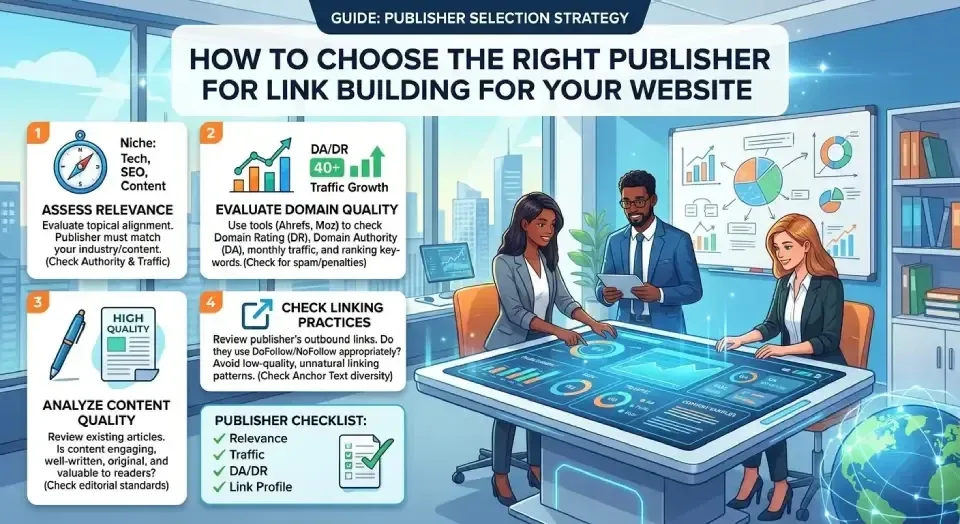
You find a website with a DA of 70 that has thousands of monthly visitors and a price that fits your budget.
It looks like an easy “Yes” and everything looks fantastic on the surface.
But then you open your senses and apply your expertise and spend five minutes on the website where you see:
The content covers almost every industry you can imagine
The audience is mostly outside your target market
Several articles you found are commercially-driven
And at last you find that the site history is difficult to understand
Now you think the other way around and does not think of:
"How strong is this website?"
Instead, you think of:
"Is this actually the right publisher to get a backlink from for my website?"
And this is the part of the link building that numbers alone cannot answer.
Choosing a publisher is not simply about finding a website with high DA/PA/DR or authority or placements.
But it is about understanding the website domain, its industry, which target audience it is catering to, what type of content it has, where or which region is it targeting, its organic visibility and the exact context where you want your link to be placed.
So, how would you choose the right publisher for link building that ticks all boxes that favours you.
We’ll talk about exactly that in this blog and by the end, you will get the answer to all your questions and learn the insights that experts avoid disclosing.
Let's break it down the concepts below brick by brick.
Want publishers that fit your niche, audience and market? Meet Link2Rank |
What Is a Publisher in Link Building?
In link building, a publisher is a website that hosts content where another website or brand may receive a mention or link.
This could involve:
A new guest post
A link added to existing content
A niche edit
Another form of editorial placement
The publisher is not just the place where your link appears.
It is the website, content environment and audience surrounding that link.
That is why evaluating the publisher matters as much as evaluating the placement itself.
Why Choosing the Right Publisher Matters
Choosing the right link publisher matters because the right link plays a vital role in driving the right target audience to your website. And the right traffic means right impressions, visits, clicks, and could the conversion (customer) as well.
Google has said it before and says often that it uses the links as a signal when determining page relevance and to discover new pages.
It also recommends descriptive, concise and relevant anchor text that gives your reader and search engines context about the linked page.
At the same time, it does not mean that every relevant backlink will improve your website rankings. SEO does not work that simply.
You have to think logically while choosing the right publisher as the goal should not to try to collect the largest possible number of backlinks but to understand which publisher opportunities make sense for your campaign.
Now that you know why choose the right publisher, let us explore the 9 things you should check before choosing the publisher.
The 9 Things You Should Check Before Choosing a Publisher
While there could be different parameters to check publishers, however, based on our conversation with the SEO experts and link building experts, we have identified the below mentioned 9 things (parameters) you should and consider before choosing a publisher.
Let us explore each of them one by one.
1. Topical Relevance
It is the first factor that you should keep in mind while choosing the publisher. And the first factor says to start with the simplest question:
Does this website make sense for your industry?
If you run SEO software, a digital marketing publication could be a natural fit.
A broader technology publication could make sense too.
But a website about gardening? It might technically accept your article. That still doesn't make it a sensible publisher for your campaign.
So look at:
The topics the website regularly covers
Its main categories
Existing articles related to your industry
The type of audience it seems to attract
Whether your proposed article would feel natural on the site
It also helps to know the difference between direct relevance and adjacent relevance.
An SEO software company publishing on an SEO website has direct relevance.
The same company publishing on a broader business technology publication has adjacent relevance.
Both can be useful, depending on your campaign.
The important question is:
Would this article naturally belong on this website?
If you have to work hard to explain why the connection exists, take another look at the publisher.
2. Organic Search Traffic
This is the 2nd necessary point you should keep in mind while choosing the right publisher.
Traffic is useful information. But the headline traffic number is only the beginning.
Let's say a publisher tells you they get 100,000 organic visits a month. That sounds impressive, doesn't it?
But before you get excited, ask yourself one simple question: what is actually bringing in those visits?
Here's what you want to find out:
Are the visits spread across hundreds of relevant pages? That usually means the site is genuinely strong in its topic.
Or do they come from a handful of unrelated articles? One viral post about celebrity news won't help your SaaS link much.
Are the ranking keywords connected to your industry? If the site ranks for things your customers search for, that's a great sign.
Are the visitors coming from the markets you care about? 100,000 visits won't mean much if they're from countries you don't sell to.
There's one more thing worth knowing. The traffic number you see in SEO tools isn't the real traffic. Tools like Ahrefs estimate it, based on the keywords a site ranks for, how often those keywords are searched, and how many people are likely to click. Ahrefs itself says its figure is an estimate, not the site's actual analytics.
So treat that number as a rough guide, not a fact.
When you're checking a publisher, look at:
Organic traffic: roughly how many visitors the site gets from search
Traffic trend: is it growing, steady or dropping over the last 12 months?
Ranking keywords: what the site actually ranks for
Top pages: which pages bring in the most traffic
Topics bringing traffic: do they match your industry?
Relevant traffic: how much of it actually matters to your campaign
Quick tip: a sharp drop in the traffic graph is a warning sign. It can mean the site has been hit by a Google update, and you don't want your link sitting on a site that's losing trust. |
In short, treat traffic as a clue to look into, not as proof that a backlink will boost your rankings.
3. Where Does the Traffic Come From?
So you've checked how much traffic a publisher gets. Now you need to know where it comes from.
Because a publisher can have strong traffic and still be a poor fit for your campaign.
You might think “Why?” The answer to your why is: “Geography.”
Imagine you're marketing B2B software to companies in the United States. You find a publisher with 80,000 monthly organic visits. Sounds good.
Then you check the country breakdown and see that most of that traffic comes from countries you don't target.
Suddenly, the opportunity looks very different.
So before you proceed ahead, do check the following:
Country and region: where most visitors are based
Language: whether the site speaks to your market
Search topics: what those visitors are looking for
Audience interests: what they care about
Target market: whether it overlaps with yours
Most SEO tools show traffic by country, so this takes a minute.
It matters most if you do international SEO or sell to specific countries. You don't need a perfect match. But you should always know who is actually visiting the website.
4. Authority and Backlink Profile
Once you know the traffic is real and in the right place, it's time to look at the number most people check first: authority.
This is where many backlink evaluations begin. It shouldn't be where they end.
SEO tools give you useful metrics like Domain Authority (DA), Domain Rating (DR), referring domains and page-level authority. Use them. Just remember what they are.
These are not Google ranking scores. They're scores created by SEO tools to help you compare websites and links.
A publisher can have a strong authority score and still have:
Weak topical relevance
Poor content
An unrelated audience
A questionable backlink profile
Too much commercial content
A site history worth looking into
So take a quick look at who links to the site, too. Real, relevant websites linking in is a good sign. Lots of low-quality or unrelated sites are not.
That's why one of the simplest rules in publisher evaluation is: Don't buy the metric. Evaluate the publisher.
Let the number guide your research. Don't let it make the decision for you.
5. Content Quality and Editorial Standards
Numbers can only tell you so much. To really know a publisher, you need to do something simple: open the website and read it.
It sounds obvious. But it's one of the easiest steps to skip when you're checking dozens of publishers.
Read a few recent articles and a few older ones, and ask yourself:
Is the content actually useful?
Is it written for people, not just search engines?
Does the writer know the subject?
Is it original?
Does the site cover its topics consistently?
Does it keep reasonable editorial standards?
Do sponsored articles look very different from the regular content?
Five or six articles will tell you a lot.
Google encourages useful, reliable and people-first content. It also recommends using links only where they make sense for readers, with clear context around them.
So before you pay for a placement, ask yourself: "Would I recommend this website to my audience, even if my backlink weren't on it?"
If the answer is no, take another look at the opportunity.
6. Check the Site's History
You've seen what the site looks like today. Now find out what it looked like before.
A website can look good right now and still deserve a closer look.
Check how it has changed over time:
The topics it used to cover
Any change in niche
How often it publishes
Content quality over time
The kind of companies it mentions
Any sudden jump in commercial content
Imagine a site that spent years covering one industry. Then, within a few months, it starts publishing about finance, health, software, travel and gambling.
That doesn't automatically make it bad. But it's worth looking into, as it can mean the site has changed hands or started selling links to anyone.
The Wayback Machine lets you see old versions of a site for free. The traffic graph in your SEO tool shows any sudden rises or falls.
The better you understand a publisher's past, the clearer it becomes what you're actually buying into.
7. Outbound Links and Commercial Content
A site's history often shows up in its links. So the next step is to look at the links it already publishes.
Ask yourself:
Does the site link to commercial websites a lot?
Are those links relevant to the content around them?
Does almost every article contain promotional links?
Do unrelated industries keep showing up across the site?
Do the links sit naturally within useful content?
This is where Google's guidance matters. Google treats buying or selling links to manipulate rankings as link spam. But it also accepts paid and sponsored links as a normal part of the web, as long as they're properly marked, for example with rel="sponsored" or nofollow.
So don't just ask, "Does this website publish paid content?"
Ask the better question:
"How does this website handle paid content and links, and what does that mean for my placement?"
8. Consider Audience Fit
By now, you know a lot about the website itself. Next, think about the people reading it.
Here's a question that deserves more attention in link building:
Would your target audience actually care about this website?
Say you sell accounting software for small businesses. A huge general website might have impressive traffic. But a smaller site focused on small business finance is read by exactly the people you want to reach.
That doesn't mean the smaller site will always give you more SEO value. It means you should look at the opportunity from more than one angle.
So ask:
Who reads this website?
What industries do they work in?
Where are they based?
What problems are they trying to solve?
Does your business fit into those conversations?
Would your content be useful to them?
Traffic tells you how many people visit. Audience fit tells you whether they're the right people.
9. Look at Price and Overall Value
You've done the hard work. Now, and only now, it's time to look at the price.
Price matters. But it shouldn't be the first thing you check.
A common mistake is to build a list of publishers and sort it from cheapest to most expensive. That turns link building into a simple price comparison.
Instead, weigh up:
Price + relevance + audience + content quality + authority + context |
And compare that with how most people judge it: Price + DA. Those are two very different ways of choosing a publisher.
A cheap placement isn't automatically good value. An expensive one isn't either. So ask yourself one last question: "What am I actually getting for this price?"
Conclusion
Remember that DA 70 website from the start? It looked like an easy "yes". But a few minutes of proper checking told a very different story.
That's the whole point of these 9 steps. DA, traffic and price are useful starting points, but they're not the full picture.
Before you buy your next backlink, run through this quick checklist:
Topical relevance: Would your article naturally belong here?
Organic traffic: Is the traffic real, relevant and steady?
Traffic location: Are the visitors in the markets you serve?
Authority: Is the authority earned, or just a number?
Content quality: Would you recommend the site without your link on it?
Site history: Has the site stayed true to its niche?
Outbound links: How does it handle paid and commercial links?
Audience fit: Would your customers actually read this?
Price and value: What are you really getting for the money?
If a publisher passes most of these checks, you've likely found a placement worth paying for. If it only looks good on one number, walk away.
Because the right link starts with the right publisher. Don't buy the metric. Evaluate the publisher.
And if you'd rather not spend hours hunting for publishers, Link2Rank gives you access to 10,000+ publishers across 55+ niches, all in one place. That way, you can spend your time choosing the right publisher, not searching for one.
Spend less time searching and more time choosing the right publishers with Link2Rank |
FAQs
1. How do I choose the right publisher for link building?
To choose the right publisher for link building, start by checking whether the website fits your industry. Then see if its organic traffic is real, steady and coming from the countries you sell to. After that, read a few articles to judge the content quality, look at the site history, and check how the site handles paid links. If it ticks all these boxes, compare the price and make your decision.
2. Is a high DA enough to buy a backlink from a website?
No, a high DA isn't enough to buy a backlink from a website. Domain Authority (DA) is just a score made by SEO tools, not by Google. A website with a high DA can still have the wrong audience, weak content or a spammy backlink profile. So use DA to build your shortlist, then evaluate the publisher properly before you pay.
3. What are the red flags to watch for before buying a guest post?
The main red flags to watch for before buying a guest post are a website that writes about every industry under the sun, promotional links in almost every article, a sharp drop in traffic, or a sudden change of niche. If you spot any of these, take a closer look. Then ask yourself: would you recommend this website to your audience even without your backlink on it? If not, walk away.
Caption
You found it.
DA 70. Thousands of visitors. A price that fit your budget.
You paid. You waited. You checked your rankings every morning.
Nothing moved.
If that's happened to you, you're not alone. And it's not because you didn't try hard enough.
It's because the number looked right, but the publisher wasn't.
It happens to so many SEOs and business owners. Hard-earned budget spent on links that never stood a chance, because the site wrote about everything, spoke to the wrong audience, or was quietly selling links to anyone who asked.
That's why we wrote this guide.
9 simple checks to help you choose a publisher that genuinely fits your brand, before you spend a single penny.
Because your budget matters. Your time matters. And your website deserves more than a pretty number.
Don't buy the metric. Evaluate the publisher.