Link Building in 2026: The Complete Guide to Earning, Building and Buying Backlinks
By Zubair Pateljiwala ·
Explore this post with:
Here's a number that should make any website owner sit up: 96.55% of web pages get zero traffic from Google (Ahrefs).
Not a little traffic. None at all.
So what are the other 3.45% doing differently? There's no single answer, but one pattern keeps showing up. Pages that get found tend to have other websites pointing at them. Ahrefs found that only about 1 in 6,671 pages with no backlinks gets more than 1,000 search visits a month.
Take Tom. He runs a small plumbing company in Leeds. His website is clean, his reviews are glowing, and his prices are fair. Yet when someone nearby searches for an emergency plumber, Tom is nowhere to be seen. His competitors aren't better plumbers. They're just better connected online.
That connection is what link building is all about.
What is link building?
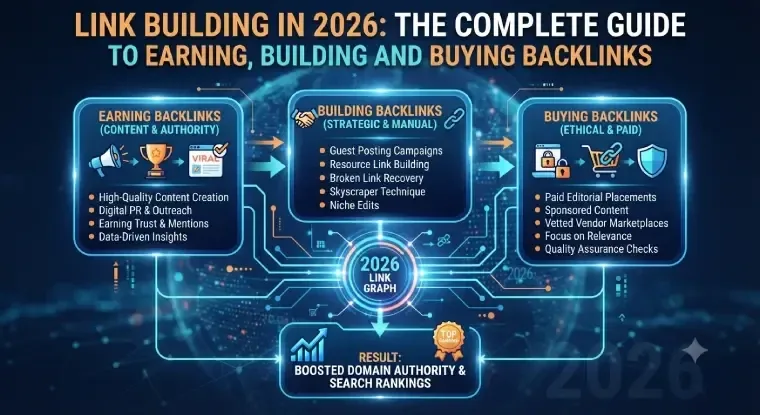
Link building is the process of getting other websites to link to yours. Each of those links, called a backlink, acts like a recommendation. It helps Google discover your pages and understand that other people trust them. In 2026, you can get links in three ways: earn them, build them through outreach, or buy them from vetted publishers.
This guide covers all three, honestly. You'll see what works, what it costs, how to plan your first campaign and the mistakes that quietly drain budgets.
Short on time? Find vetted publishers in your niche on Link2Rank |
Chapters
What is link building, really?
Why links still matter in 2026
What makes a link worth having
Three ways to get links: earn, build or buy
How much does link building cost?
Your first link building plan in 6 steps
How to measure results
Mistakes that waste your budget
Link building and AI search
Quick glossary: 10 terms to know
1. What is link building, really?
In this chapter: the three words you need to know before anything else.
Link building means getting links from other websites to your own. A backlink is one of those links. A referring domain is a website that links to you, however many times it does so. Ten links from one site still count as one referring domain.
Think of it like word of mouth in a busy town. If one neighbour mentions Tom's plumbing, that's nice. If the local paper, the community Facebook group and three builders all recommend him, people start to trust him. Google works in a similar way, except the recommendations are links.
If you're completely new to all this, start with our beginner's guide, then come back here for the practical side.
With those three words in your pocket, the rest of this guide gets much easier.
2. Why links still matter in 2026
In this chapter: what Google itself says about links, and what the data shows.
Links still matter because they're one of the main ways Google finds your pages and judges whether they deserve to rank. You don't have to take our word for it. Google's own SEO Starter Guide says:
"Google primarily finds pages through links from other pages it already crawled. In many cases, these are other websites that are linking to your pages." — Google Search Central
And a little further on:
"In fact, the vast majority of the new pages Google finds every day are through links, making links a crucial resource you need to consider to help your pages be discovered by Google and potentially shown in search results."
The ranking data points the same way. In Backlinko's analysis of 11.8 million Google results, the page in position 1 had, on average, 3.8x more backlinks than the pages in positions 2 to 10 (Backlinko). That's a correlation, not proof that links alone did it, but it's hard to ignore.
Myth or fact? "Links don't matter any more. Content is all you need."
Myth. Great content is essential, but Google still has to find it and decide it's worth trusting. Content and links work as a team. Even Google says other sites linking to you "happens naturally over time, and you can also encourage people to discover your content by promoting your site."
So the real question in 2026 isn't whether to build links. It's which links are worth your time and money.
3. What makes a link worth having
In this chapter: the six things that separate a great link from a useless one.
A good link comes from a relevant, trusted website with real readers, sits naturally inside the content and uses honest, descriptive anchor text. The more of these boxes a link ticks, the more it's worth.
Here's what to look at:
Relevance. Does the site cover your topic? A link from a home improvement blog is gold for Tom. A link from a crypto news site is noise.
Authority. Is the site trusted, with links of its own? Scores like Domain Rating (DR) and Domain Authority (DA) give you a rough guide.
Real traffic. Do real people actually read it? This matters more than any score.
Placement. Is the link in the main body of an article, as one of the contextual backlinks, rather than in a footer or sidebar?
Anchor text. Are the clickable words natural and descriptive, rather than stuffed with keywords?
Label. Is a paid link marked with rel="sponsored", the way Google asks?
One SEO on Reddit put the traffic point perfectly: "If it's a lower-scoring site but it's got 50 people on every day who are prospective customers, that's much more valuable." (Reddit)
Tom's note: a small Leeds property blog with a DR of 25 but thousands of local readers is worth far more to Tom than a national site with a DR of 80 that never mentions plumbing.
If you remember just one thing from this chapter, make it this: high authority backlinks only help when they're also relevant.
4. Three ways to get links: earn, build or buy
In this chapter: the honest pros and cons of every route to a backlink.
There are three ways to get links. You can earn them by creating something worth linking to, build them by reaching out to site owners, or buy them from publishers through a trusted link building marketplace. Most successful sites use a mix of all three.
Earn: make something people want to link to
Earned links come from content, research or stories that other sites choose to mention. They're the most natural links you can get.
Useful content. Guides, tools, templates and original data. Content marketing is the most popular link tactic of all, used by 68% of SEOs in Aira's survey of 270 professionals (Aira).
Digital PR. Newsworthy stories and data pitched to journalists. In Editorial.Link's 2026 survey of 518 SEOs, 48.6% rated digital PR the most effective tactic (Editorial.Link).
Brand mentions. Being quoted, reviewed or listed by people in your industry.
The catch? Earning links is slow and unpredictable. You can do everything right and still wait months.
Build: ask for links through outreach
Building links means contacting site owners and asking for a link, usually through a guest post, a resource page or a partnership. Guest posting alone is used by 47% of SEOs, according to Aira.
It works, but it's a numbers game. Backlinko analysed 12 million outreach emails and found that only 8.5% got any reply at all (Backlinko). That's a lot of emails for a handful of links.
Buy: order placements from vetted publishers
Buying links means paying a publisher to feature your link in a guest post or an existing article. It's far more common than people admit: an Authority Hacker survey of 755 link builders, reported by Ahrefs, found that 74.3% buy backlinks.
It's the fastest route, but only safe when you buy from relevant, real sites and label the links the way Google asks.
Earn vs build vs buy at a glance
Earn | Build | Buy | |
Effort | High | High | Low |
Speed | Slow | Medium | Fast |
Cost | Time and content | Time | Money per link |
Control over where you appear | Low | Medium | High |
Main risk | No results for months | Very low reply rates | Bad sellers and spammy sites |
Tom's note: Tom doesn't have time to write research reports or send 200 emails a week. He starts by buying a few placements on local home and property blogs, then earns links later by sponsoring a youth football team.
Want the fast route without the risk? Browse vetted publishers on Link2Rank |
There's no prize for using only one method. Pick the mix that fits your time, budget and goals.
5. How much does link building cost?
In this chapter: real numbers, so you can budget with your eyes open.
Link building costs anything from the price of your time to thousands a month. It depends on your niche, the quality of the sites and whether you pay per link or hire a managed link building service.
Here's what the research shows:
Guest posts: $77.80 on average, and niche edits $361.44, in an Ahrefs study run a few years ago (Ahrefs).
One high-quality link: SEOs said $508.95 is an acceptable price (Editorial.Link).
Monthly budget: $8,406 is the average minimum monthly budget SEOs say you need in highly competitive niches.
Don't panic at that last figure. It's for the toughest niches. A local business like Tom's can make real progress with a much smaller, steadier budget.
Ways to pay
Per link. You choose each site and pay for each placement. Best for control.
Link building packages. A set number of links for a fixed price. Best for predictability, as long as you can see the sites.
Managed service or agency. Someone else runs the whole campaign. Best if you have budget but no time.
Myth or fact? "Cheap links are a smart way to save money."
Myth. A link that costs a few pounds usually comes from a site nobody reads or trusts. You're not saving money, you're wasting it.
Whatever you spend, judge each link by what it brings, not by its price tag.
6. Your first link building plan in 6 steps
In this chapter: a simple plan you can start this week, even with a small budget.
A good link building plan starts with the pages you want to rank, not with the links you can get. Follow these six steps and every link you add will have a clear job.
Check where you stand. Use a free tool such as Google Search Console, or a paid one like Ahrefs or Semrush, to see how many referring domains you already have and which pages earn them.
Pick two or three target pages. Choose pages that matter to your business and already rank on page 2 or 3. These are the easiest to push up.
Study your competitors. Look at who links to the pages that beat you. That shows you which kinds of sites and how many links you need.
Choose your methods. Decide your mix of earning, building and buying, based on your time and budget.
Start small and steady. A few strong, relevant links every month look natural and are easier to judge than a sudden burst.
Track and adjust. Every month, check what moved and put more effort into what worked.
Tom's plan: Tom picks his "emergency plumber Leeds" page and his "boiler repair" page. He sees his top competitor has links from local news and home improvement blogs. So each month he buys two placements on relevant home blogs, asks his suppliers to list him as a recommended installer, and pitches one local story to the Leeds press.
If you can only do one thing this week, do step 2. Knowing your target pages makes every other decision easier.
7. How to measure results
In this chapter: the four numbers that tell you if it's working.
You measure link building by watching your referring domains, the rankings of your target pages, your organic traffic and whether your links are still live. Check them once a month, not once a day. Links take time to work.
What to track | Where to find it | What good looks like |
Referring domains | Ahrefs, Semrush, Google Search Console | Steady growth from relevant sites |
Target page rankings | Search Console or a rank tracker | Moving up, even slowly |
Organic traffic | Google Analytics 4 | More visits to your target pages |
Links still live | A backlink checker | Every paid link still in place |
Don't judge a link after a week. Google needs time to find it and weigh it. Give each campaign at least three months before deciding whether it's working.
8. Mistakes that waste your budget
In this chapter: the traps that catch most beginners, and how to avoid them.
The most expensive link building mistakes are buying from spammy sites, ignoring relevance, stuffing anchor text and chasing scores instead of real readers. Each one can cost you money, and some can cost you rankings.
Buying from PBNs and link farms. These are networks of sites built only to sell links. They're cheap for a reason.
Ignoring relevance. A link from a site that has nothing to do with your business does very little.
Stuffing anchor text. Using the same keyword in every link looks unnatural. Mix in your brand name and plain phrases.
Buying too much, too fast. Fifty links in a week from a brand-new site looks suspicious.
Chasing DR alone. Ahrefs itself warns: "DR doesn't account for backlink SPAM. In fact, large amounts of low-quality backlinks may actually increase your DR, not decrease it." (Ahrefs)
Falling for bulk deals. As one Reddit user put it: "If someone is offering 500 backlinks for $50... that's usually a red flag." (Reddit)
Myth or fact? "More links is always better."
Myth. Ten links from relevant sites your customers read will usually beat a hundred from sites nobody visits. Quality and relevance win, every time.
Shortcuts rarely last. Another Reddit user summed it up: "Trying to beat the system only works temporarily until the algorithm catches up." (Reddit) White hat backlinks take a little longer, but they keep working.
9. Link building and AI search
In this chapter: what links mean for ChatGPT, Gemini and Google's AI Overviews.
Links and brand mentions can help AI tools understand who you are and what you're known for, but nobody can guarantee you'll be cited. AI answers tend to draw on sources that are trusted and widely referenced, which is exactly what good link building builds.
A few simple principles:
Be mentioned where your topic lives. If Tom is named on Leeds home and property sites, AI tools are more likely to connect "Tom's Plumbing" with "plumber in Leeds".
Keep your brand details consistent. Use the same name, description and services everywhere you appear.
Spam won't help here either. Links on irrelevant or low-quality sites don't make AI tools trust you more.
The good news is that you don't need a separate AI strategy. Build links that real people would value, and you're already doing most of the work.
10. Quick glossary: 10 terms to know
In this chapter: the words you'll hear most, in plain English.
Term | What it means |
Backlink | A link from another website to yours |
Referring domain | A website that links to you (counted once, however many links it gives) |
Anchor text | The clickable words of a link |
Domain Rating (DR) | Ahrefs' score of a site's link strength, from 0 to 100 |
Domain Authority (DA) | Moz's score of how well a site might rank, from 1 to 100 |
Dofollow link | A normal link that can pass trust to your site |
Nofollow link | A link marked rel="nofollow", asking Google not to pass trust |
Sponsored link | A paid link marked rel="sponsored" |
Guest post | A new article on another site that includes your link |
Niche edit | Your link added to an article that's already published |
FAQs
What is link building in SEO?
Link building in SEO is the work of getting other websites to link to yours. Those links help Google discover your pages and act as signals of trust. You can earn links with great content, build them through outreach, or buy them from vetted publishers on a link building marketplace.
Is link building still worth it in 2026?
Yes. Google's own SEO Starter Guide says the vast majority of new pages it finds every day are found through links. Relevant, trusted links still help pages get discovered and ranked. What has changed is that quality and relevance now matter far more than the number of links.
How many backlinks do I need?
There's no fixed number. Look at the pages that outrank you and count their referring domains from relevant sites. That gives you a realistic target. For a local business, a handful of strong local links can be enough. Competitive national keywords usually need many more.
How long does link building take to work?
Most links take weeks to a few months to show their full effect, because Google needs time to find and weigh them. Give any campaign at least three months before judging it. Pages that already rank on page 2 usually respond fastest.
Can I do link building myself?
Yes, especially earning links through content and building local links through suppliers, partners and the press. It just takes time, as only 8.5% of outreach emails get a reply. Many businesses do some themselves and buy placements through a marketplace to save time.
How much does link building cost?
It ranges from the cost of your time to thousands a month. In an Ahrefs study, guest posts averaged $77.80 and niche edits $361.44. SEOs say $508.95 is an acceptable price for one high-quality link. Local businesses can start with a much smaller, steady budget.
Back to Tom
Six months on, Tom's "emergency plumber Leeds" page has links from local home blogs, a supplier's installer list and one story in the local press. It now sits in the top three. He didn't do anything magical. He chose relevant sites, grew steadily and judged every link by whether his customers would actually see it.
That's link building in 2026 in a nutshell. Earn what you can, build what you have time for, and buy carefully from sites that are genuinely worth it.
"Most businesses don't have a link problem, they have a relevance problem. Ten links from sites your customers actually read will do more than a hundred from sites nobody visits." — Zubair Pateljiwala, Founder, Link2Rank
Start Building Links That Actually Count
Explore the Marketplace: 10,000+ vetted publishers in 55+ niches, with a live link guarantee.
Start Building Links That Actually Count |